
Contact us
We'd love to chat about classes, performances, or whatever else is on your mind!
Mass Capoeira
Looking for something other than capoeira?
Mass Capoeira is the capoeira program of  Agora Culture Center, which runs the building's fitness, wellness, arts, and youth programs. Enquiries about those are best sent their way.
Send us a message
We'd love to chat about classes, or whatever else is on your mind.
Looking to book a performance or workshop? Fill out our event request form.
Frequently asked questions
Can't find your answer? Send us a message above, or email info@masscapoeira.com.
What is capoeira?
Capoeira, pronounced ka-poo-eyh-rah, is a rich Afro-Brazilian tradition that incorporates elements of martial arts, dance, music, and language. Initially developed as a form of resistance by enslaved peoples in colonial-era Brazil, today capoeira is one of the most widely recognized symbols of Brazilian heritage and identity, and is a main vehicle for the dissemination of Brazilian culture and Portuguese language around the world.
What are some of the benefits of capoeira?
Capoeira serves as a healthy outlet for children and practitioners of all ages, providing opportunities for physical exercise, artistic expression, personal development, and cultural exploration and exchange. Through this holistic, mind-body-soul experience, practitioners will develop confidence and discipline; physical strength, balance, and control; and skills in martial arts, music, and foreign language.
What style of capoeira is practiced at Mass Capoeira?
At Mass Capoeira, we practice a style known as Capoeira Regional Contemporânea (Regional Contemporary Capoeira). This style is derived from movements and sequences developed by Mestre (Master) Bimba in the mid-20th century (Capoeira Regional).
Capoeira Regional Contemporânea is generally considered to be a more explosive, martial style of capoeira with fast rhythms, rapid kicks, high-flying acrobatics, and dynamic clapping.
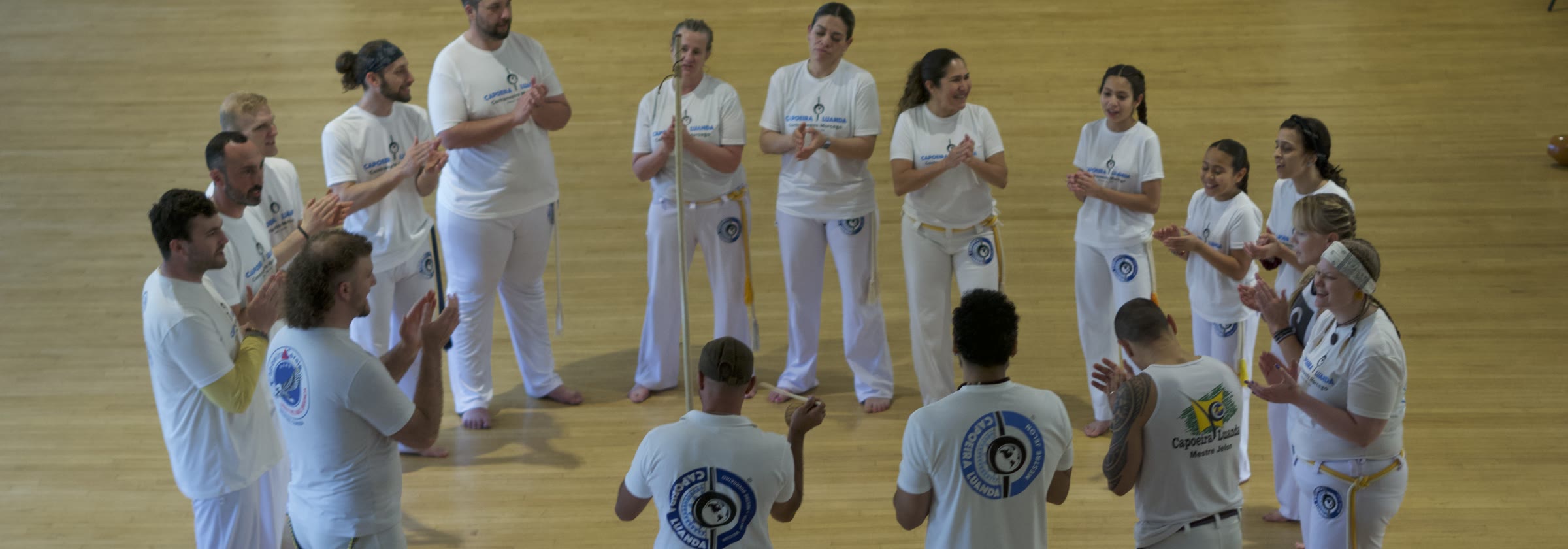
Mass Capoeira is part of Capoeira Luanda, an international capoeira group founded in 2007 by Mestre Jelon Vieira.
What classes does Mass Capoeira offer?
Mass Capoeira offers adult capoeira classes (ages 14+) and a Special Needs class at the Webster studio. Kids classes (ages 6-12) and a family class run at the Greendale YMCA in Worcester. Visit our schedule page for class days and times.
Please contact us for information on class schedules or to discuss teaching a class at Mass Capoeira.
What should I wear to class?
Please wear comfortable athletic clothing, such as yoga pants, leggings, sweatpants, and t-shirts. Do not wear baggy or oversized clothing that could present a tripping hazard.
It is traditional to train our style of capoeira without shoes, and most of our students choose to play barefoot. However, you may also choose to wear light, flexible running shoes, cross-trainers, or other athletic footwear with flexible soles.
Once you are ready to commit to becoming an official student of the school, we will ask you to purchase a Capoeira Luanda uniform, which consists of white pants (called abadá) and a white logo t-shirt.
Bring a water bottle or any other beverage that you need to stay hydrated – we have cold filtered water available at the studio.
How much do Mass Capoeira classes cost?
Your first class is free. Memberships can be bought online — see our pricing for current rates and options.
Family discounts and referral bonuses are available. Please ask for more information!
What types of performances and community programs does Mass Capoeira offer?
Mass Capoeira performances and workshops can be easily tailored to any group or context, no matter the age or experience level. We can quickly design programs lasting from ten minutes to two hours that include a combination of music, movement, language and culture. Programs include:
- Performances and demonstrations (dance, live music, etc.)
- Interactive workshops
- Birthday parties
- Community fairs and events
- After school programs
- Family programs
- Library programs
- Multicultural events (e.g., Martin Luther King Day celebrations, Brazilian Independence Day, Black History Month, Latin-American Heritage Month)
Please visit our Performances page for more information and visuals, and contact us to book a program.
How much do Mass Capoeira community programs cost?
Mass Capoeira programs typically range from $300 - $1,000/hour, depending on the number of participants, type of program, and the specific needs of the sponsoring organization. Please contact us for information about how we can design a program for your budget.
Who is Contramestre Morcego?
Alexandro Silveira, known as Contramestre Morcego, is a martial artist, musician, and graphic designer who serves as the leader of Mass Capoeira. Born in Salvador, Bahia, the cultural home of capoeira, Contramestre Morcego has more than 30 years of experience training and teaching capoeira throughout Brazil and the US, including at local institutions such as Worcester Polytechnic Institute and Clark University. He also directs Vertical Black, our custom screen printing shop, and is co-owner of Na Rasteira, a capoeira-inspired fitness apparel line.
Where does the word "capoeira" come from?
While the exact origin of the word “capoeira” is debated, it is generally believed to originate from the Tupi (a large indigenous group in Brazil) language and to refer to the areas of low vegetation in the Brazilian interior where fugitive slaves used to hide.
What does the name "Capoeira Luanda" mean?
The word “Luanda” has rich significance in the history of capoeira. It is rooted in the languages of the Bantu and Yoruba African peoples, where it has various meanings as a sacred, mystical land.
Luanda is also the name of the capital city of Angola, a southwestern African nation and former Portuguese colony. The city of Luanda was the largest port from which enslaved peoples were placed on ships and forcibly relocated to Brazil. For millions of enslaved peoples, the shores of Luanda were the last views of the motherland they saw before embarking on the long journey across the Atlantic Ocean. For this reason, the names Luanda and Angola carry deep spiritual meaning, and feature prominently in the history and traditions of capoeira.
Is capoeira a dance or a martial art?
Capoeira is a martial art that incorporates elements of music, dance, and acrobatics.
The music and dance-like elements of capoeira are commonly believed to have helped enslaved peoples in colonial-era Brazil hide the fact that they were practicing martial arts from slave owners and law enforcement officials, by disguising it as a dance.
The use of percussion instruments in war dances goes back millennia in African traditions, and can also be seen in the modern-day practice of maculelê, an Afro-Brazilian war dance often performed by capoeiristas in public ceremonies. Capoeira likely had roots in ancient African war-dance rituals such as Engolo (N’Golo).
You may hear people say that capoeira is just a dance or that it is not a real martial art. Even though it has less direct physical contact than some other martial arts styles and incorporates music and dance-like elements, it is still very much a martial art.
Is capoeira dangerous?
Like any martial art, capoeira involves a certain degree of risk. The powerful kicks, swift takedowns, and challenging acrobatic movements that define capoeira may result in injuries, which is why we do our best to prepare our bodies, respect our training partners, and execute movements as safely as possible.
Over the hundreds of years of its existence, capoeira has served as a tool for survival, a form of resistance, and even a weapon of intimidation at the hands of gangsters and corrupt political officials in Brazil. In fact, capoeira was once considered so dangerous that it was outlawed in 1890 (shortly after the abolition of slavery in Brazil in 1888), and was not legalized again in Brazil until the 1930s.
All those who would like to try capoeira must first sign a waiver to participate.
What instruments are used in capoeira?
Capoeira involves the use of several percussion instruments, all of which have African roots. These include the berimbau (a one-string guitar), atabaque (drum), pandeiro (tambourine), and agogo (a small percussion instrument). The full group of instruments is referred to as the “bateria.”
A typical Capoeira Luanda bateria includes 7 instruments:
- 3 berimbaus (gunga, medio, viola)
- 1 atabaque
- 2 pandeiros
- 1 agogo
Is capoeira religious?
Capoeira is not formally associated with any religion. However, capoeira does borrow some concepts from religious traditions, such as the “batizado” or baptism ceremony, which serves as an initiation into the art, and the practice of kneeling before the berimbau before entering a capoeira roda. Some people also believe that the tradition of wearing white has roots in religion, as practitioners would often participate in capoeira rodas while wearing their “Sunday best” on their way to and from attending religious church services.
While capoeira does not have any formal religious connections, it’s important to understand capoeira within the context of the culture and history of Brazil. Since the time of the Portuguese colonizers, Catholicism has been the dominant religion in the country. The enslaved peoples also brought their own African traditions, which they fused with Catholicism and other local indigenous religions. Candomblé is an example of an Afro-Brazilian religion that combines elements of Catholicism, African, and Amerindian indigenous traditions. As a result, it is very common for capoeira songs to incorporate references to God, Catholic Saints, and African deities and spirits. While capoeira is not religious, it is extremely spiritual. It is natural for capoeiristas to bring their own traditions of religion and spirituality into their practice of the art.